Thursday, June 26, 2008

Swim, swim, swim

Daniel started swimming therapy. We tried this a couple months ago and it was a HUGE no go.
He cried, he screamed, and his little arms moved quicker than I ever imagined they could. We tried it for about 3 weeks, the minute I would start to head down the hallway to the changing room, tears started flowing. We even tried it with his big sister getting in the pool with him. Nope, no can do. I couldn't figure it out because Daniel LOVES water, absolutely loves it. You turn on the water to do dishes and he runs across the room in the walker just to see the water. Loves the bath, the shower, running his hands in water, the water table at therapy, he loves swimming in our pool. Take him to swim therapy and he loses his mind! So we stopped. It was productive and he was more worked up than anything else, it wasn't helping him.

So after our Florida trip and Daniel almost living in the pool at GKTW village, we decided to try it again, at a different pool, with his favorite therapist! ....and here are the results!


To explain to you how incredible Daniel's PT is and how much she cares about the kids she works with. She knew how badly I wanted Daniel to do swim therapy. When we started it months ago it was at a different location with a completely new PT. Part of why he hated it, he didn't know the PT and he was scared, wasn't comfortable with it. His regular PT, also wanted Daniel to use the pool. Well our regular PT location doesn't have a pool in the Pediatric Rehab department. She actually went and found that there was a small pool in the Adult Rehab, on a completely different floor,same building, that no one knew about. She went to her manager and asked for special approval to let HER take Daniel into the pool. Then they had to get the approval from a completely different department (Adult Rehab). She pulled a lot of strings. Prior to Daniel no child had gotten swim therapy at this building! I think that is completely and totally the coolest thing. Daniel felt comfortable with someone he's been with for 2 1/2 yrs, and is doing so well with it. I am very thankful to have her as Daniel's therapist. She has been a life saver in so many ways. Countless!

My Gold Star Award goes to Ms. Carol!


Wednesday, June 25, 2008

Sad, Happy, Sad, Happy....Aw Hell I Don't Know Anymore

We picked up Daniel's 3rd pair of AFO's.
Does this photo make anyone else sad? Besides me?
It makes me sad because
  • He's only 2 1/2 yrs old and no child should have to have leg braces...its just not fun.
  • Its sad that he has a condition that means he'll probably have these types of braces for a really long,long time
  • Just the fact that they started off so small and look how big they are now...means the baby is growing up!
  • Just another thing to make him look different than other children his age
  • They just represent 'a struggle'

It makes me smile because

  • It gives him the strength to stand on his legs and work his muscles. It gives him that extra little umpf to get his walker going.
  • They help give him his independence and freedom
  • They give me hope, that there is a chance that he WILL walk with his head held high, and he will conquer this struggle, and he will inch his way along. It may be a slow process, but he WILL get there.

Never imagined I could resent an object as much as I do his AFO's and then turn around and love them for other reasons. Oh the emotional roller coaster we live! UP one minute and Down the next. Sad, Happy, Sad.....

Anyone know what to do with used AFO's?

Thursday, June 19, 2008

Sigh of Relief!

Imagine this:

Sitting down at your computer and opening up an email that the subject line says
Re: Daniel S.


Do you feel dread too?! I did!

Opening it and reading this:


Hi
Good news! Everything looks good.
EEG - no epileptic activity. Background waves a little slow - that's because of the syndrome - doesn't worry us at all. And both VEP and ERG are normal!
Let me know if you need anything else.
Kathy


As my daughter would say "Hells yeah!" Me I just sat there and re read it about 5 times, cried and then got up and did the happy dance! It you're not sure what the happy dance is, click here!

Yesterday we went to the hospital got all these tests done and Daniel did not like them one bit. I actually broke down and cried in front of everyone during the second test because he was so upset and they had to give him medication to relax him. Hell I'd be upset too if I was strapped to a stretcher and my arms taped down not being able to move for over an hour. Plus he was overheating from being wrapped up and taped down and screaming. Just got to me this time, just how shitty it is that he has to go through this crap. I know there are other children out there that have to go through far worse then we do. And my heart aches for you, it really truly does.

This was Daniel's 3rd clean EEG since he was on ACTH. This means we can now start to wean Daniel off his seizure medication and the only meds he will be on is for drooling and constipation. Which if I can start to get him to eat things like prunes and such, we will be off that too.

So, 6 weeks from now...Daniel will be off Vigabatrin (hopefully for good!) NO MORE INFANTILE SPASMS. Now please realize that I know we are not completely out of the woods because with his brain malformation (CBPS) seizures will ALWAYS be a great possibility. I know this. But for right now......they are frickin' gone!!

This also means that we can start back up on the TES therapy, the TENS therapy, and the VitalStim therapy! I will hopefully in a few months have a little body who has a stronger trunk, who can swallow better than before, and who will be more alert and aware because he is mostly drug free.

On another note: Daniel started doing swim therapy and he isn't screaming like he was a month ago when we first tried and had to stop because it wasn't productive!! I'll post pictures later of that one. I have to get his therapists permission ;)

Wednesday, June 18, 2008

Being Special Needs Parents - Reality 101

Smacked in the face with a sledge hammer? Yeah that about sums it up!

Here is a really great article that I happened upon in my many many searches through the past 2 1/2 years. This one fit me perfectly when I first found it, and still does now. I check back to this article frequently to see what "stage/state" I am in. Sometimes I think I'm in "acknowledging" but then I fall back into "grieving/anger". I wonder....will I ever be in that final stage? I accept Daniel for who he is, and I wouldn't change much. The only thing I can say that I would change is that I wish he didn't have to struggle. Nothing is worse that seeing your baby struggling and crying, not understanding why he can't get down and run with the other kids. Nothing is worse than seeing in his eyes, that he understands he is different, and I dread the day he asks me "why?" Because I don't think I can answer that. Because someone played a really frickin' cruel joke on us..., because God thinks you need to be this way (I won't get into the religion aspect cause I'm not sure where I stand with that still) Anyways........read on, let me know your thoughts.

The Impact of Childhood Disability: The Parent's Struggle by Ken Moses, Ph.D.

I was taught that the way to deal with adversity or pain was to "tough it out." If you could avoid showing the pain, then you had "beaten the rap," and dealt with the problem competently. I am a psychologist who works with people who are grieving over profound losses. Few would argue that facing the devastating and continuing loss of having an impaired child is among the most painful experiences that a person can confront. After working with parents of the impaired for many years, I have come to believe that I was given bad advice. I have come to believe that pain is the solution, not the problem.

Parents, all parents, attach to their children through dreams, fantasies, illusions, and projections into the future. Children are our second chance, our ultimate "life products," the reflection and extension of our very being. To know that a human life exists that grows from our genes, our bodies, that is a result of our existence, brings a measure of spirituality into the most hardened individual. Something basic to our sense of being is stirred when we witness the miracle of the continuity of life. What happens when this core experience is marred irreversibly by disability? How does a parent survive the devastation of a handicap in their child that shatters their heartfelt dream? How do they go on? How can they help their child, their other children, themselves?

Before I started working in this field, I noted that people who faced adversity basically became better or worse; none stayed the same. What made the difference? Some parents seem to pull their lives together around their child's impairment, others go to pieces.
Over fifteen years ago, I ran my first parent group comprised of mothers of children with special needs. These people helped me enormously as I started to answer some of the important questions that relate to coping with childhood impairment.

I began the group using traditional group psychotherapy methods, an approach designed to intervene on psychopathology. That approach did not work for a simple reason: those mothers were not suffering from pathologies, they were reeling from the impact of having disabled children. Gradually I let go of the old way of doing things and permitted myself to listen and learn from this courageous group of parents. Slowly, a pattern emerged that surprised me. It became evident that these people were manifesting a grieving process. This left me confused. It was clear that they were alternately anxious, angry, denying, guilty, depressed or fearful, but they were not internally "disturbed" people. Conversations focused on experiencing regrets, being overwhelmed, and other feeling common to people who are bereaved. My puzzlement: "Who died?" At that time, my understanding of grief was simple, concrete, and exclusively tied to death.

What followed was a remarkable process. The group members struggled with a number of concepts that led us all to some powerful contemplations about parental grief. Is it the loss of a "normal" child? Is it the disruption of one's "normal" lifestyle? Is it the sense of shame or humiliation that is experienced with family, friends, or other peers? Is it the profound disappointment that some experienced with the ineffective responses of their ostensible support group? We might have shared such thoughts endlessly, until I formulated a key question that helped to bring these diffused feelings and thoughts into focus. It came out innocently enough: "Think back to when you were anticipating the birth of your child. Who (or what) was this child to have been for you? What followed was a remarkable outpouring of poignant, anguished human sharing that, to this day, serves as the foundation for understanding and working with parents of impaired children.Parents attach to children through core-level dreams, fantasies, illusions, and projections into the future. Disability dashes these cherished dreams. The impairment, not the child, irreversibly spoils a parent's fundamental, heartfelt yearning. Disability shatters the dreams, fantasies, illusions, and projections into the future that parents generate as part of their struggle to accomplish basic life missions. Parents of impaired children grieve for the loss of dreams that are key to the meaning of their existence, to their sense of being. Recovering from such a loss depends on ones ability to separate from the lost dream, and to generate new, more attainable, dreams.

As disability bluntly shatters the dreams, parents face a complicated, draining, challenging, frightening, and consuming task. They must raise the child they have, while letting go of the child they dreamed of. They must go on with their lives, cope with their child as he or she is now, let go of the lost dreams, and generate new dreams. To do all this, the parent must experience the process of grieving.

Grieving is an unlearned, spontaneous, and self-sufficient process. It consists of states of feeling that provide the opportunity for self-examination, leading to both internal and external change. The grieving states that facilitate separation from a lost dream are as follows: denial, anxiety, fear, guilt, depression, and anger. The word "states" is used instead of "stages," to emphasize grieving is not a step-by-step process that evolves through discrete stages. This depiction of what a parent goes through is a presentation of theory, not irrefutable fact. It is meant to help people find their own ways of dealing with the unspeakable. I look at it as a map, not a recipe. A recipe tells people what to do if they desire a particular result. A map, on the other hand, is one person's partial impression of reality that can be used by another to help them get to where they wish to go.
When theories of grieving are used as a recipe to produce acceptance, two false premises are inflicted on parents. The premise that grieving should move through a specific order is flatly inaccurate. A consistent pattern is not evident in people dealing with loss! Worse, when people believe that they are supposed to grieve in a certain way, they often end up thinking they are doing it wrong. Secondly, the concept of acceptance is totally unfounded. In almost twenty years of working with bereaved people, as well as dealing with my own losses, I have never seen anyone achieve acceptance of loss, only acknowledgement. Belief in the concept of acceptance leads parents into feeling like failures for not being able to attain it. Any use of grieving theory as a recipe is strongly discouraged.

Though the feeling states of grieving do not adhere to any strict order, there is a loose pattern that can be detected. Denial is always first, but may reemerge again and again, as often as the parent needs to experience it. Anxiety generally follows denial, but it can follow other feeling states as well. It is not uncommon for two or more feeling states to be experienced at the same time. Different families are more or less comfortable with showing certain feelings while discouraging others. In short, each person who goes through the grieving process experiences each of the feeling states, but does so in their own unique manner and order.

It is clear that this spontaneous, unlearned grieving process is central to the well-being of the child and parent alike. It is the only way that one can separate from a lost cherished dream. Many people do not make it. They have their dreams shattered by disability and collapse emotionally under the assault. Resisting the grieving process, they hold feelings in, blame self or others, become embittered, dependent, or even bizarre in their interactions. They can range from the selfless crusader to the deserter, from the alcoholic to the workaholic, from the outrageously high strung to the person who barely moves or talks. However they manifest their stuckness, these are the people who have become worse, not better, in response to loss. These are the people who could not or would not experience the feelings of grieving. Many of them resisted the process because their subculture (their family, neighbors, church, schools, and friends) sent out a consistent message: the feelings of grieving are not acceptable! Others foundered because they were stuck emotionally before they had their impaired child. Regardless of background, people become worse if they resist experiencing and sharing the spontaneous feelings of grieving. Each feeling state, no matter how negative, serves a specific and helpful function. To separate from a lost dream, one must experience and share denial, anxiety, fear, guilt, depression and anger in whatever order or manner the feelings surface.

The Feeling States of Grieving

1. Denial People who deny are considered stupid, obstructionists, dull or deliberately irritating by many who have to deal with them. None of that is true. Parents of impaired children manifest denial as a normal course of trying to deal completely with loss. It is impossible to live life fully while maintaining an awareness of the awful things that can happen to people. Most people routinely shield themselves with such thoughts as "The terrible things that happen to other people can't happen to me, because...


This system works fine as long as nothing terrible happens, but when it does, no one is prepared to deal with it. This is where denial in the service of grieving comes in. Denial buys the time needed to blunt the initial impact of the shattered dream, to discover the inner strengths needed to confront what has really happened, and to find the people and resources needed to deal with a crisis for which one could not be prepared.

2. Anxiety When a person loses a dream that is central to their being, they are forced to make major changes within themselves and within their environment. To deal with having an impaired child, parents go through dramatic changes that affect their attitudes, priorities, values, and beliefs, as well as altering day-to-day routines. Such changes require a great deal of energy. Anxiety mobilizes the energy needed to make these changes. Further, it gives focus to that energy so that the changes can be actualized. Anxiety is the inner source of the need to act.


Anxiety is generally seen as hysterical, inappropriate, and unacceptable. The culture's message is clear. As a rule we advise anxious people to "calm down," to take medication, or to use alcohol as a "solution" for the "problem" of anxiety. These unsolutions keep the parent from changing and often make things worse for all concerned. Realities must be faced, stressful as they might be. It does not take long for most parents to become aware that they, not some professional, are their child's medical, educational, and therapy managers, even though they may have minimal knowledge of these areas. That alone should drive home the urgent need for energies to be mobilized and focused by the crucial feeling of anxiety.

3. Fear As anxiety mobilizes people to deal with change, fear is a warning that alerts the person to the seriousness of the internal changes that are demanded. One's sense of balance and order are dramatically challenged when one confronts a meaningful loss. The parents experience the terror of knowing that they will be required to change on a fundamental level, against their will, with full understanding that the process of internal change is very difficult.
Significant losses produce a profound sense of abandonment and vulnerability. We have a number of sayings to cope with this level of fear, e.g., "It is far better to have loved and lost, than to have never loved at all." Each person must find their own words to confront the sense of abandonment and vulnerability generated by a significant loss. Most parents experience the fear of vulnerability about having more children after they have had an impaired child, or about "over-protectionism," the gut-wrenching fear of permitting their impaired child to do anything that feels risky. Given the ways that this part of grieving is manifest, it should not be difficult to see that fear is the medium that encourages the struggle to reattach, to love again in the face of a loss.

4. Guilt Parents of impaired children manifest guilt through the normal course of grieving and are often criticized for doing so. Guilt is a feeling state that has become so identified with being neurotic that people feel guilty about feeling guilty. Since sharing such feeling often evokes negative judgments, it can be difficult for a sophisticated parent to talk about guilt freely. On the surface, guilt-ridden people may appear not only neurotic, but superstitious, ignorant and primitive. They are often viewed as unpleasant, uncomfortable people to be with and therefore are dismissed or treated harshly by friends, family, and professionals.
Generally, parents of impaired children express guilt in one of three ways. One way is by telling a story that explains how they are responsible for their child's handicap. Their story is often accurate and, on the whole, persuasive. The current emphasis on the prevention of birth defects has brought many parents to feel that they caused their child's impairment. The issue is not the logic, but the feeling of guilt. Another way that guilt is manifested is in the conviction that the child's impairment is punished for a past inappropriate thought, feeling, or action. One of the more common "guilt thoughts" is regretting the pregnancy sometime during gestation. When something goes wrong after that thought occurs, "it's all my fault" becomes a natural outcome. Lastly, guilt can be expressed through the parent's belief that good things happen to good people, and bad things happen to bad people. Because parents have an impaired child, they must be bad people. Because they have an impaired child, they must be bad people and consequently feel shame and guilt. How can such painful explanations of tragedy be useful to bereaved individuals? Simply by being explanations. Guilt "explains" the unexplainable.

Human beings began to question the "why" of things from very early on in their lives. What are the rules which govern the way of things: cause and effect as well as right and wrong? A most important "why" concerns how one's "right" or "wrong" actions effect one's life. What difference does it make that a person is moral, ethical, legal, caring, ambitious? How is it that one does or does not influence the events of one's life? Some of us found early and easy answers to these questions and have not considered them since. After a loss, such questions cannot be answered in an ordinary fashion. Rather, they must be addressed through the kind of grief-related struggles addressed here. When people confront a loss, the beliefs they held regarding cause and effect, right and wrong, and their impact upon life are deeply shaken. The order of things is totally upset when an innocent child suffers. The parent experiences deep pain, pain that can be used to reorder the rightness of the world. Guilt is the feeling state that facilitates this struggle to reorder. Basically the guilt-ridden person is saying that they are accepting responsibility for everything. It feels better to do that than to believe that they have no influence on anything! Guilt, in this sense, helps one to redefine the issue of cause and responsibility in the light of loss.

5. Depression A common response to loss often is characterized by profound and painful sobbing. Parents report that at times it feels as though the tears will never stop. There is a rest, but then for no apparent reason, waves of despair and anguish wash over the parent once more. Between the tears, one can sit alone, staring silently. Those periods of silence can last well beyond the periods of tears. The thoughts of depression take over, thoughts like: "What's the use of trying, it's all over,," or "Nothing I do matters, because nothing will change what has happened to my child!" Depression is subtly rejected and judged as pathological by much of our culture. When people display such feelings, they are often told to "cheer up", given medication, or offered distractions. Such responses are inappropriate, for depression is part of normal, necessary, and growthful grieving. It attends to another aspect of a basic human struggle that loss stirs.

As we mature, we develop and modify our definitions of the following words: competence, capability, value, and potency. They are words of profound personal significance. They are the criteria that people use to decide if they are OK or not. What criteria does a person have to meet to feel like a competent parent, a capable worker, a valued friend, or a strong person? Each person determines these standards privately, even secretly. When parents are confronted with an impaired child, whatever definitions they held for competency, capability, value, and potency usually no longer apply. How does a mother feel competent when she has a retarded daughter? She can't use the measures of her peers, like having a daughter graduate from college, or become homecoming queen. What is the worth of a father who cannot "fix" what is broken in his impaired son? Out of this struggle of defining one's worth come the frightening feelings of helplessness, hopelessness, and haplessness. Faced with loss, a parent feels unable to act effectively (helpless), unable to imagine that things will ever get better (hopelessness), and unable to believe that their lives are touched by good luck (hapless).

Such feelings are terrifying for both the parents and those around them. For that reason, it is hard to see that depression is a normal and necessary part of the grieving process. Depression is the medium that helps parents come to new definitions of what it takes to be a competent, capable, valuable and strong people, even though their child has impairments that they cannot cure.

6. Anger Anger, for many people, is the most disconcerting of the feeling states. It too is a natural and necessary part of the grieving process. Parents feel anger at the harm done to their child and the shattering of their dreams. When one encounters a significant loss, it is likely that one's internal sense of justice is severely challenged. To continue to trust in the world, one must have a sense of justice that confirms an orderliness and fairness to the way the world works.

A parent can righteously demand to know why he or she has an impaired child: "Why me, why not you!" Implicit in the question is the notion that there must be good reason that such a thing happens to one parent and not to another. A parents'concept of justice, like value and worth, is another unique product of that individual's thinking and development. When confronted with the traumatic loss of a dream, that internal sense of justice is violated. Crying out in the face of injustice, the parent develops new ways to look at justice in the world. "What, after all, is fair, if this can happen?" Anger is the medium through which a parent redefines fairness and justice. It integrates new beliefs within the deepest emotional levels of the grieving parent.
Unfortunately, anger is an emotion that is actively rejected by the culture at large and by people closest to the parent. The angry parent experiences rejection by others, confusion about feeling anger and acting out the feeling, the feeling of being out of control. All of this makes it very difficult for this important feeling to run its course.
Anger also poses other dilemmas. Unlike the other feeling states of grieving, anger is directed toward someone or something. Who (or what) is the object of parental anger? This question deeply distresses most parents, because the honest answer is often so troubling that many people avoid asking themselves the question. The unacceptable answer, of course, is that the impaired child is the object of anger. After all, who has entered this parent's life, disrupted it, caused immeasurable pain, and drained the parent's time, energy, and money.
Most parents were raised to believe that feeling and expressing negative feelings about one's child is taboo. "The child never asked to be handicapped, let alone to be born. How can one be reasonably angry at this child?" If the child is blameless, than it must be unreasonable to feel anger toward the child-even though one does! The conflict between what parents feel and what they can permit themselves to express can cause a return to denial. Another outcome of this conflict is that the parent can displace the anger onto others. Spouses, non-impaired siblings of the impaired child, and professionals are all possible targets of this displaced anger.

When considering the feeling states of grieving, especially the feeling state of anger, logic and reason are irrelevant. Where is the logic behind cursing a rug that one has just tripped on? What is the purpose of kicking a flat tire? What good does it do to admonish anyone after they have already done the wrong thing? Expressing simple anger clears the way to getting on with the task at hand. Expressing anger opens the way to address the meaning of justice (though enacting angry behavior sidetracks the parent from the task at hand). While there is no logic, there is purpose and function to the expression of angry feelings. As events occur that violate one's sense of justice, the outrage must be expressed. Those expressions help to redefine one's concepts of fairness and justice.

The parent of an impaired child separates from dreams that were shattered by impairment through grieving. Denial, anxiety, fear, depression, guilt, and anger all emerge. If they are shared with other people, these feelings help parents grow and benefit from what might be the worst tragedy of their lives. Grief must be shared deeply and fully until the underlying issues are revealed. The reopening of these issues changes the parent's world view. New perceptions of themselves and their world serve as a solid foundation for coping with the disability and for personal growth. Yielding to the grieving process helps parents find the inner strength and external support needed to face profound loss; to mobilize and focus the energies needed to change their lives; to reattach to new dreams and loves in spite of feeling abandoned and vulnerable; to redefine their criteria for competence, capability, value, and potency; to reassess their sense of significance, responsibility, and impact upon the world around them; and to develop new beliefs about the universal justice system that makes the world a tolerable place to live, even though terrible losses can occur. The culturally rejected feeling states of denial, anxiety, fear, depression, guilt, and anger may be used in surprisingly positive ways when the feelings are fully shared. Perhaps you can see now why I think that experiencing and sharing the pain is the solution, not the problem. Through my life I have experienced many losses. For many years I dealt with these losses by stifling feelings, workaholism, toughing-it-out, and innumerable other ways that kept me from experiencing what had happened to me. I became one of the "walking wounded" that I was committed to helping. Ironically, it was not until I myself had a child with impairments that I began to take the advice that I had so freely given to other parents. I started to yield to the natural and necessary process of grieving. Like everyone else, I discovered that only now am I growing with the impact of the loss. I will continue to grieve and to grow as my child and I develop and experience new losses and new strengths.


Those of you who actually read through that whole article, please post a comment, I'd like to get your take on it. If you have a child that is special need, where are you in the process and what did you do to make things easier?

I will be the first to admit, I think I've hit every state that is mentioned. I have gone through the depression, I have gone through feeling defeated, feel that my self worth is NOTHING, that maybe things would be better without me being there. I know deep in my mind that this is not my fault, it is a fluke. My brain may know this, but my heart doesn't. But please if you are reading this, I have never blamed Daniel for anything, he didn't ask for it. Blame or anger is NEVER at Daniel....now it maybe at other people, but never Daniel. I have anger issues...I get very angry at people who make silly comments (that I never realized before but am more sensative too) like, Thank God he fell asleep that kid doesn't shut up. I just want to shake that parent and hold them by the shoulder and say "Count your blessings, at least YOU get to hear your childs voice, at least your child can voice what they want, at least your child can look at you and tell you that they love you, at least your child can say mama. Count your blessings"

Please read my *Disclaimer* the section in red.

Please post a comment, but please understand we all feel differently and no one is right and no one is wrong in how they feel, so no bashing me for my feelings. I have told people in my life before, just because you say I should feel one way doesn't mean I do, and just because you tell me to get over it, doesn't mean I will, and I can cry if I want to damn it.......this is my child, this is my life.....DON'T TELL ME HOW TO FEEL, because I won't tell you.

And please no comment like: He doesn't understand so be thankful he doesn't know any different. 1- He does understand 2 - He knows what he can see, and he can see other children doing things he can't. 3- Let me repeat for those of you who didn't understand me the first time. Just because Daniel has some physical disabilities does NOT mean he is stupid or like some say "retarded". HE UNDERSTANDS EVERYTHING YOU ARE SAYING. So think twice before you speak and make an ass of yourself, because if you don't realize your mistake when you make it, I will point it out and you'll hear it loud and clear. Don't make my child feel inadequate with your comments, don't belittle him with your words, or I will do just the same to you. :) Yes , (nodding my head) Yes, I know.......What a bitch.
But you know what--- I don't care what you think. Really I don't. Its a reality.

Can you guess what "state" I'm in?!

Monday, June 16, 2008

Take Me Out To The Ball Game


On Father's Day we took Daniel to his first Detroit Tigers Baseball game.

I had the brilliant idea that I would just carry him instead of putting him in his Kimba stroller.

MISTAKE #1. This kid is heavy!

When we arrived at the game it was nice, bright and sunny. So because of Mistake #1......I worked up a sweat. Its difficult enough to carry a child who is as long and as heavy as Daniel, but then add in there that when he gets excited, he extends (meaning he is as stiff as a board and there is no breaking it up!) and he can't wrap his legs around my waist, doesn't yet have the muscles to do that.

Well in honor of it being Daniel's first baseball game we got him a hat and a t-shirt! As you can see in the photo above he looks smashing in his new duds! Check out his eyes......he is eyeballin' the guy behind us because he had food and Daniel wanted it!

He was having fun and we were eating and being merry when it started to rain. And I don't mean sprinkling either...a downpour. Again, pick up Daniel and attempt to run for cover...although it was indeed funny, he thinks rain is cool, so again he goes into extension and is harder than heck to carry! Game was on rain delay for about 45 minutes, and after sitting/standing/carrying for that amount of time....we decided to just leave and go home.

LOL I wouldn't say it was a successful trip to the ball game, but it wasn't a complete failure either! Note to self: BRING KIMBA STROLLER!
On another note: Yesterday was my mom and dad's birthday. If you've followed the blog you know that my mom passed away in November of last year, so this is the first year that we won't be celebrating her birthday. My father passed away about 7 years ago. All I can say is that now that they are back together...I hope that they had a wonderful day where ever they may be, and I am sure they were both happy because they were with each other. Here is the last birthday we celebrated with my mom (June 07), you'll see a picture of her with all of my children. My dad celebrated his last birthday alive in the hospital, he passed away shortly afterwards. My mom, and his children were all in the hospital room to celebrate their birthday. I'm sure the nurses loved that!! I would post a picture of that as it was a very tender moment when my mom leaned over the hospital bed railing to give my dad a birthday kiss. So..........mom and dad, happy birthday.....I miss you and I hope you are happily together again.

Thursday, June 12, 2008

*DISCLAIMER*

In Daniel's "welcome page" we say that we basically invite you along for the journey of Daniel's life, and the ups and downs. Times throughout the day I think of things and mentally note, "That is something I should blog about. Or I wonder if other people think or feel this way." I'm not real good at words or writing things. I basically write what comes to mind, there is no organization to it, its generally a bunch of ramblings. I write it, the computer along with blogger does the "draft auto save", I save it in draft, re-read it sometimes and then publish the post. Generally Lonnie comes and read its later and amends it, changes the words around to sound the right way, and fixes my errors. These errors are usually because I only have a few minutes to type up what I want people to see (Daniel's progress, doctor reports, test results etc.), and I type how I think, instead of how it should be in proper English!
In Daniel's welcome page we say, "we hope you find this site informative and helpful on dealing with the issues (diagnosis) emotionally and physically of a child who has special needs." And I think so far I've done a pretty good job on what Daniel has to go though. But I really haven't touched base on what having a "special needs" child does to a family.
So in the next few weeks you'll see some posts about how the crap that Daniel has affects a family, other peoples lives that Daniel is involved with, and its not always a pretty picture. People might read this and think "Wow she's a bitch", but I want people to understand that this crap is hard, it is hard on the child, and it is hard on the family. And the words that a doctor says to you in a small white room, will change you. It will change who you were, and you will migrate into a person you never knew existed. (Oh and did I tell you...YOU DON'T HAVE A CHOICE...this is your life!) So if I am a b*tch....so be it. I am not going to change, this is me, as F*cked up as I may be....you will get what I am thinking....if my feelings on issues make me a b*tch, well then I'm ok with that. Now I will say this repeatedly I am sure:

DISCLAIMER: I, in no means would take Daniel out of my life. He is my everything, and I love him more than I can express. I love waking up in the morning and seeing him smiling at me, I love cuddling with him. He is amazing, he has taught me things, he has made me feel things that I never expected to feel. And I pray to God that I never have to miss those feelings. I don't think I could exist without Daniel. So what I write about the "crap" is because I HATE, I LOATHE the issues that Daniel has. I do NOT hate Daniel, I do NOT loathe Daniel, I do NOT resent Daniel. But I do hate and wish he did not have to do the things he has to do.

And I will also the things that are published here are solely my opinion, they aren't necessarily fact, they are just what we as a family are going through, or what I have spoken or heard from other parents.

Monday, June 9, 2008

Are YOU ready for summer?

Are you ready for summer? Remember to protect your peepers!!Don't you just love when you forget about something and then weeks, months or some times years later you find it? Like if you put $20 in your pocket of your winter jacket, then the next year you are putting that jacket back on and YIPEE you're $20 richer! Well that is exactly the feeling I got this weekend but it was more like a million dollars!
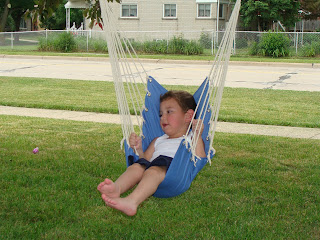
This weekend, I was digging in the back of the closet (can't even remember why) and I found a swing that I got on EBay 2 years ago. This little hammock swing. But when I got it in the mail, it was the exact timing of Daniel getting his diagnoses so in my depressed state I threw it to the back of the closet floor and figured we'd never be able to use it. There it has sat for the past 2 years (OKAY - NO I DON'T CLEAN OUT MY CLOSETS OFTEN!!) until we found it the other day. It was one of those moments where you're so happy that you do the happy dance.... so for the past two days, Daniel has been happy happy happy.
Check out the eyes below...they are closed. What a way to take a little nap eh?!
Now its time for our new bike!! But in the hot weather we had (90 degrees) we didn't last too long on the bike. Just long enough to get a couple pictures and ride for a few. Then it was off to the pool.
Doesn't he look like such a big boy?? He certainly doesn't look like he's 2 1/2 to me!!Just posting this picture because I wanted people to see how great Daniel is doing with supporting himself. Now if we could just get that trunk a little bit stronger, so many great things will come. But for now, isn't this awesome? Bearing weight on his arms is a huge thing, and look at that supported noggin!
Here is what happens after a full day of activity. I guess we did a little too much. For those of you who know Daniel personally, you are aware that it is very hard to get him to sleep and once he is asleep to wakens up very very easily. The video is kind of long, but I found it so funny (except for my brief moment of panic at the end!). So watch it at your own risk!